
 India
India
Introduction
Entrepreneurs in the UAE must decide on one of three company jurisdictions: Mainland, Free Zone, or Offshore. These options differ fundamentally – from market reach and ownership to tax and compliance. Choosing the wrong structure can mean paying taxes you didn’t need, losing access to customers, or investing in the wrong licenses. For example, a Free Zone company cannot directly sell in the UAE without a local distributor, and an Offshore entity cannot sponsor visas or conduct local trade. On the other hand, a Mainland company offers full UAE market access but requires a physical office and is subject to 9% corporate tax on profits over AED 375,000. This guide breaks down each options, their advantages, limitations, costs, and ideal use-cases, so you can make a strategic choice for your business.
What Are the 3 Business Jurisdictions in the UAE?
- Mainland (Onshore) Company: A Mainland company is licensed by the Department of Economy & Tourism (DET) or an emirate’s Economic Department and registered with the UAE Ministry of Economy. It allows unrestricted trade across all seven emirates – with the public, private firms, and government agencies. Mainland companies must lease a physical office (with Ejari registration) and adhere to federal regulations. Following the 2021 Company Law reform, most Mainland LLCs now allow 100% foreign ownership (a few strategic sectors remain restricted).
- Free Zone Company: A Free Zone company is established within a designated free zone (special economic zone) and regulated by its Free Zone Authority. The UAE hosts over 40 free zones (e.g. DMCC, DIFC, JAFZA) each targeting specific industries. Free zones grant 100% foreign ownership, 0% corporate tax on qualifying income, and customs duty exemptions within the zone. Setup is fast with flexible office options. However, free zone firms cannot trade directly on the mainland without a local distributor or separate Mainland licence.
- Offshore Company: An Offshore company (International Business Company) is formed under special offshore laws (e.g. RAK ICC in Ras Al Khaimah or JAFZA Offshore). Offshore entities are intended solely for international trade, holding assets, and wealth management – not for UAE market activity. They allow 100% ownership and offer high privacy (no public shareholder registry), but they cannot conduct any business in the UAE, lease an office, or sponsor visas. Offshore companies serve as holding structures for property, patents, or overseas trade flows.
Quick Comparison Table
| Factor | Mainland | Free Zone | Offshore |
|---|---|---|---|
| Ownership | Up to 100% foreign (most sectors) | 100% foreign (all activities allowed in zone) | 100% foreign (no restrictions) |
| UAE Market Access | Full access: trade anywhere in UAE; bid on govt contracts | Limited to free zone area (and international). Can sell to mainland only via distributor. | None: business outside UAE only |
| Permitted Activities | Any commercial, industrial, service (2,000+ DED licences) | Pre-defined list (100–300 activities) per zone | Holding, int’l trade; no UAE operations |
| Corporate Tax | 9% on profits > AED 375,000 | 0% on qualifying income (if QFZP conditions met); otherwise 9% on non-qualifying income | Tax-exempt (no UAE-sourced income) |
| VAT (5%) | Standard 5% on taxable supplies in UAE | 5% on services; 0% on goods in designated zones | Generally not applicable (no local sales) |
| Office Requirement | Dedicated office (Ejari) required | Flexible: virtual desk or small office (substance needed) | None (registered agent address) |
| Visa Eligibility | Visas unlimited (based on office size) | Quota-based per licence package (limited) | None (offshore cannot sponsor visas) |
| Compliance | UAE corporate tax filing + VAT (if applicable); audit only if large turnover | Mandatory annual audit and substance for 0% tax; VAT if goods shipped from zone | Minimal (only registrar filing); stricter banking due diligence |
| Cost (2026) | High – ~AED 30,000–40,000+ (1st year, incl. licence + office) | Mid – ~AED 18,000–34,000 (licence + flexi-desk + visas) | Low – ~AED 8,000–25,000 (no office/visa costs) |
| Setup Time | 2–4 weeks (due to approvals & Ejari) | 1–5 business days (pre-packaged licences) | 1–3 business days (minimal checks) |
| Ideal For | Local retail, F&B, hospitality, clinics, construction (B2C); major projects | Export traders, e-commerce/wholesale, freelancers, tech agencies (80%+ intl revenue) | Holding company, global trading (no UAE footprint), asset/IP holding |
Mainland Companies (Detailed Analysis)
- Full UAE Market Access: Mainland businesses can operate freely across the entire UAE, including selling to consumers in any emirate and bidding on government contracts. This makes them ideal for retail shops, restaurants, clinics, construction, hospitality, and other B2C/B2B operations that rely on the local market.
- 100% Foreign Ownership: Thanks to the 2021 company law, most Mainland licenses now allow 100% foreign shareholder ownership. (Only a limited “Negative List” of strategic sectors – such as banking, security, and utilities – still require a UAE partner.) Foreign investors can fully own their Mainland ventures in most cases.
- Unlimited Visa Capacity: Visa quotas for Mainland companies are tied to the office size, effectively allowing unlimited work visas as long as you lease sufficient space. This is advantageous for scaling staff.
- Government Contracting: Only Mainland companies can bid for government tenders and carry out public-sector projects, opening higher-value opportunities.. This access is a major draw for construction, engineering, and service firms targeting Emirate government clients.
- Corporate Tax and Compliance: Mainland companies pay UAE corporate tax at a flat 9% rate on profits above AED 375,000, and are subject to regular VAT (5%) on taxable supplies. Unlike Free Zone entities, Mainland firms are not automatically audited each year – only large companies must submit audited financials.
- Higher Setup Costs: A Mainland trade licence and office can be costly. Setup fees (license, approvals, Ejari-registered office) typically run AED 30,000–40,000+ for the first year. Ongoing costs (annual renewals, utilities, staff visas, etc.) are also higher than in Free Zones.
- Ideal For: Businesses that need a local presence. If you expect the majority of your revenue (>50%) from UAE-based customers or consumers, or require a storefront/office for walk-in business, Mainland is the appropriate choice. It’s also best if you plan to establish multiple branches across emirates or employ large teams.
Free Zone Companies (Detailed Analysis)
- 100% Ownership & Tax Benefits: Free Zone licences guarantee 100% foreign ownership and full repatriation of profits. Qualifying companies can enjoy a 0% corporate tax rate on eligible income, subject to meeting substance requirements. (Note: 0% is not automatic – the firm must qualify as a “Qualifying Free Zone Person” by incurring local expenses, having office space and staff, and keeping non-qualifying revenue low.)
- Streamlined Setup: Free Zone authorities offer pre-approved packages, so incorporation can often be done in 1–5 business days. Many zones provide flexible office options (virtual desks or co-working) to lower overhead.
- Customs and Infrastructure: Free Zone companies benefit from customs duty exemptions on goods entering the zone for export, and world-class logistics or tech infrastructure (e.g. JAFZA for trade, DMCC for commodities, Internet City for IT). There are no foreign currency restrictions, and 100% of capital/profits can leave the UAE freely.
- Limitations on UAE Market: A critical drawback is that Free Zone firms cannot directly sell to UAE mainland customers. To serve the domestic market, you must appoint a local distributor/agent or open a Mainland branch/license. Any income earned on the mainland is subject to 9% corporate tax and can jeopardize your 0% status if not structured carefully.
- Compliance Requirements: Maintaining the tax-free benefit requires ongoing compliance: annual audited financials, substance tests, and strict adherence to qualifying activities. Small companies should budget for audit fees. Visa quotas are limited by the free zone package (the cheapest licences may include few or no visas). Also, each Free Zone only permits activities in its sector, so you must match your business type to the appropriate zone.
- Ideal For: Free Zones suit international-oriented businesses. Import/export traders, e-commerce and wholesale ventures, tech startups, freelancers and consultancies (IT, marketing, media) often opt for Free Zone licences. In general, if 80% or more of your revenue comes from clients outside the UAE, a Free Zone entity is a strong fit.
Offshore Companies (Detailed Analysis)
- Low Cost & Privacy: Offshore companies have the lowest setup costs (typically AED 8,000–25,000 depending on services) since no office or visa is required. They offer high confidentiality – shareholder and director names are not made public – which is attractive for wealth holding and privacy. Incorporation is very fast (often 1–3 days) with minimal capital requirements.
- Asset Holding Structure: An Offshore company is ideal as a holding vehicle. It can own UAE property (in selected emirates), hold patents, shares in other companies, and operate international trading arms. Profits from overseas business remain effectively tax-exempt.
- Restrictions on UAE Operations: By law, Offshore companies cannot conduct business within the UAE market. They cannot sponsor any UAE residence visas, cannot rent commercial office space, and cannot invoice local clients. Their only permitted activities are offshore – e.g., holding assets or trading goods/services that never enter the UAE.
- Banking Considerations: UAE banks are permitted to open accounts for Offshore companies, but the process can be more stringent and time-consuming due to global KYC/AML checks. Plan for additional documentation and bank processing time.
- Ideal For: High-net-worth individuals and multinational investors use Offshore structures for wealth management and international operations. An Offshore entity is well-suited for a holding company (real estate, investment portfolio, intellectual property), estate planning, or a trading vehicle when the market is overseas. It provides asset protection and a tax-efficient way to channel investments globally.
Free Zone vs Mainland vs Offshore – Deep Comparison
- Ownership & Control: Mainland LLCs now allow up to 100% foreign ownership in most activities. Free Zone and Offshore companies have always guaranteed 100% foreign ownership. Note that a small list of “Strategic Impact” sectors (e.g. banking, telecom) still impose local partner requirements on the mainland.
- Business Activities: Mainland licences cover thousands of activities (over 2,000 options in major emirates), supporting retail, contracting, manufacturing, and local services. Free Zone licences are more specialized (typically 100–300 activities), focused on trade, tech, media, or industry. Offshore companies cannot perform any trading or services in the UAE at all – their role is strictly asset holding and external operations.
- Tax Implications: Both Mainland and qualifying Free Zone companies are subject to the UAE corporate tax regime (9% on taxable profits above AED 375,000). Free Zone entities that meet the Qualifying Free Zone Person (QFZP) criteria can still access a 0% rate on qualifying income, but failure to maintain substance triggers 9% on all income. Offshore companies pay no UAE tax on foreign-sourced income. All companies (Mainland or Free Zone) must register for VAT if turnover exceeds AED 375,000, with most in-scope transactions taxed at 5%.
- Banking & Compliance: All companies must file beneficial ownership (UBO) details and comply with AML rules. Free Zone entities claiming 0% tax face mandatory annual audits and substance documentation, whereas Mainland audits are only required if above certain thresholds. Both Mainland and Free Zone businesses generally find it straightforward to open UAE bank accounts, whereas offshore entities face extra due diligence by banks.
- Scalability & Expansion: Mainland companies can open branches anywhere in the UAE and sponsor unlimited visa quotas tied to office capacity. A Free Zone company is capped by its visa quota, but can expand by taking larger packages or adding a mainland arm later. Offshore companies cannot expand within the UAE; any local expansion requires establishing a new Mainland or Free Zone company.
- Cost Differences: Mainland setup is the most expensive due to license and office rent (often AED 30k–40k+ first year). Free Zone incorporation is moderately priced (AED 18k–34k). Offshore is cheapest (AED 8k–25k) since it has no office or visa costs. Remember to factor renewal fees (typically 70–80% of initial cost) and ancillary expenses: visa processing (~AED 3,000–6,000 per visa), annual audits (Free Zone), and corporate tax filings. Cheap upfront cost (Offshore) may not suit businesses needing UAE operations.
Case Recommendations
- Freelancers & Consultants: Most freelancers (e.g. IT consultants, marketing professionals) benefit from a Free Zone licence. You get 100% ownership, quick setup, and minimal overhead. If clients are international or online, a Free Zone (with a small flexi-desk) is ideal. If you plan to work only with UAE clients (e.g. local consultancy), a Mainland licence might be considered for credibility and visa flexibility.
- E-commerce Businesses: For online retailers selling regionally or globally, a Free Zone is often preferable. Free Zones like JAFZA or Sharjah Media City cater to e-commerce with logistics support and tax exemptions. However, if your e-commerce platform targets UAE consumers directly, consider a Mainland license so you can hold local inventory and offer faster domestic delivery. In many cases, entrepreneurs start in a Free Zone and later add a Mainland branch once local demand grows.
- Trading Companies: If your trading is international (import/export, commodity trading), a Free Zone trading license (e.g. DMCC, Jebel Ali) provides zero customs duties and tax breaks. For domestic distribution (selling goods within the UAE), a Mainland license is required to clear customs and serve local retailers. Multi-entity structures are common here: an offshore or Free Zone entity holds goods, with a Mainland entity handling UAE sales.
- International Holding / Investment: Offshore companies are built for this. Use an offshore structure (RAK ICC, ADGM, etc.) to hold global shares, IP, or UAE real estate while minimizing taxes. Offshore ensures asset protection and confidentiality for high-net-worth individuals or multinationals looking to centralize international operations. In some cases, an ADGM Free Zone company (which also permits 100% foreign ownership and offers family office licenses) may serve a similar purpose.
- Startups & Tech Firms: Early-stage tech or digital startups often choose Free Zones (like Dubai Silicon Oasis, DMCC, or Mainland if targeting UAE market). Free Zones give 100% ownership and relaxed office requirements, which is ideal for founders. If the startup expects to grow a local user base or requires local funding/business development, Mainland might become necessary. According to local experts, “for most tech, consulting or digital service startups, a Free Zone company remains the most practical entry point”.
- High-Net-Worth Individuals (Wealth Structuring): Offshore jurisdictions are typically best for wealth management. An Offshore company (or Abu Dhabi’s ADGM Free Zone) offers anonymity and estate planning benefits. Use it as a vehicle to hold property and investments globally. HNWIs should consult specialists to coordinate real estate ownership (which may require specific UAE permissions) and trust structures.
Cost Comparison (2026 Insight)
As of 2026, Mainland company setup is significantly more expensive than alternatives. Typical first-year costs are AED 30,000–40,000+ (including DET license and mandatory Ejari office rent). Free Zone packages run AED 18,000–34,000, bundling the license, flexi-desk office, and a small visa quota. Offshore companies cost roughly AED 8,000–25,000 to incorporate, since there is no office or visa expense.
However, consider the total cost of ownership: Mainland and Free Zone licenses renew each year (often at 70–80% of initial fees), and visa renewals (AED 3,000–6,000 per visa) add ongoing costs. Free Zone entities must also budget for annual audits and corporate tax filings if applicable. In practice, the cheapest initial option (Offshore) may still incur costs if you need to later open a UAE branch. Always compare license fees in context – a slightly higher licence fee might include more visa quotas or services.
Common Mistakes to Avoid
- Choosing by Cost Alone: Selecting the jurisdiction with the lowest setup fee can be costly later. For example, Offshore is cheapest up-front, but it gives no UAE market access or visas. Similarly, Free Zone may be cheaper than Mainland initially, but if you cannot serve local customers, you may need to set up a second Mainland company.
- Ignoring Your Market: A common error is picking a Free Zone without realizing it cannot sell directly in the UAE. If your target customers are local, a Mainland license is necessary. Conversely, if most clients are abroad, do not overpay for Mainland benefits you won’t use.
- Neglecting Visa Plans: Offshore structures provide no visa. Free Zones limit visas by package, and cheap packages may include few visas. If you plan to work or hire staff in UAE, ensure your chosen setup can sponsor the required visas.
- Underestimating Compliance: Some entrepreneurs assume Free Zone companies automatically pay 0% tax. Since 2023, Free Zone entities must actively qualify for this rate. Failing to maintain substance or mixing too much non-zone income means a 9% tax penalty on all profit. Always factor in audit costs and substance requirements when calculating savings.
- Overlooking Long-Term Needs: Focusing only on short-term ease (e.g. setting up in a convenient zone) without a plan for growth can backfire. Consider whether you may need a Mainland expansion, additional licenses, or a holding structure as you scale. Many savvy businesses end up using multiple entities (free zone + mainland + offshore) for optimal reach.
How to Choose the Right Jurisdiction
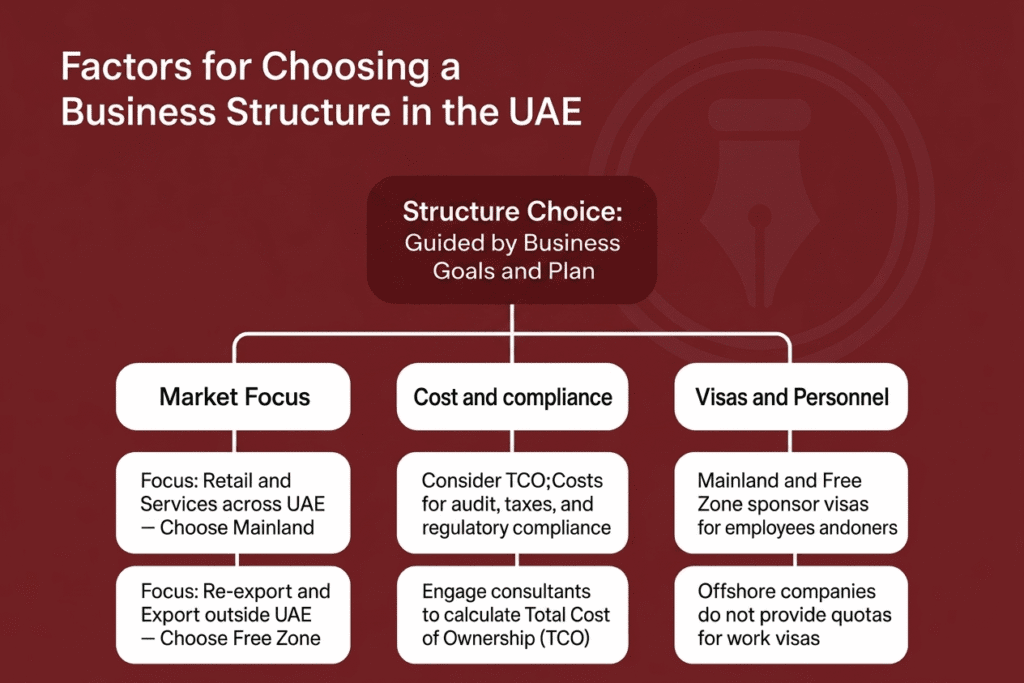
Making the right choice depends on Market Focus, Compliance Appetite, and Visa/Staff Needs. Consider the following steps:
- Identify Your Market: Are most of your clients UAE residents or international? If you plan to sell directly to UAE consumers, operate retail stores, or bid on local projects, a Mainland licence is likely required. If your customer base is primarily overseas or B2B, a Free Zone or Offshore structure can offer better tax and ownership advantages.
- Check Allowed Activities: Ensure your intended business activities are permitted. Mainland licences cover almost any legal activity; free zones each have a fixed activity list (so choose a zone aligned with your industry). Offshore setups are limited to investment/holding functions.
- Assess Ownership & Control: Both Mainland and Free Zone now permit full foreign ownership. Verify whether your activity is on any strategic list requiring a local partner. Decide how much voting or board control you need.
- Evaluate Visa and Space Needs: Estimate how many visas you will sponsor. Mainland visas scale with office size. Free Zone visas are limited by licence tier. Offshore companies offer no visas, so use Mainland/Free Zone for families or employees.
- Compare Costs vs Benefits: Mainland setup is costlier (license + office) but offers the broadest scope, whereas Free Zone is cheaper with tax breaks. Offshore is cheapest but very restricted. Include renewal fees, visa costs, and compliance fees in your budget.
- Plan for Compliance: Mainland companies must file corporate tax and VAT returns (if applicable). Free Zone firms seeking 0% tax must prepare annual audited statements and meet substance rules. Ensure you have the expertise or professional support to maintain compliance.
- Build a Multi-Entity Strategy: Many businesses use a combination of jurisdictions. For example, a Free Zone company for international trade plus a Mainland branch for local sales provides the best of both worlds. Engage experts to map out the optimal structure for your goals.
FAQ (Frequently Asked Questions)
- Is a Free Zone company better than a Mainland company in the UAE?
It depends on your business model. Free Zone companies are ideal for export-oriented or international businesses that need 100% ownership and tax incentives. Mainland companies are preferable if you must serve the UAE market or bid on government contracts. Mainland offers wide customer access and unlimited visas (with a proper office), while Free Zone offers faster setup and can be cheaper for cross-border trade. - Can offshore companies operate in the UAE?
No – offshore companies are legally prohibited from conducting business within the UAE. They exist only for international activities and asset holding. An offshore company cannot lease commercial space, invoice UAE customers, or sponsor any residence visas. - Which is the cheapest business setup in Dubai?
Offshore company formation is generally the least expensive (around AED 8,000 and up) since no office or visa fees apply. Dubai Free Zone packages start from roughly AED 18,000–34,000, including license and flexi-office. Mainland companies are most expensive (AED 30,000–40,000+ in the first year) due to higher license and rental costs. Remember that the cheapest initial option may not be the most cost-effective long-term if you need local operations or visas. - Can foreigners own 100% of a UAE Mainland company?
Yes. As of the 2021 corporate law changes, most commercial activities on the UAE Mainland allow 100% foreign ownership. Only a small “Strategic Impact” list (e.g. banking, telecommunications, defense) still imposes local shareholding. For almost all trading, service, and industrial licenses, foreign investors can now control the entire company. - Can a Free Zone company trade on the UAE mainland?
Not directly. A Free Zone entity cannot sell goods or services to UAE mainland customers unless it partners with a local distributor or obtains a separate Mainland license. Any revenue earned within the mainland will be subject to 9% corporate tax, and significant mainland income can jeopardize your Free Zone tax benefits. If you need to serve the local market, plan for a Mainland setup in addition to your Free Zone entity.
Conclusion
Choosing the right UAE jurisdiction is a strategic business decision. Mainland setup provides full domestic market access and straightforward regulation (at a higher cost). Free Zone offers 100% ownership and potential tax relief for internationally-focused firms, but requires meeting strict compliance criteria. Offshore structures deliver asset protection and low cost for global activities, with no UAE market reach. In today’s 2026 landscape – with corporate tax fully in force and tightened Free Zone incentives – careful planning is more important than ever.
AB Nexis’s senior consultants bring deep UAE jurisdiction expertise to guide you beyond mere paperwork. We analyze your business model, market targets, and growth plans to recommend the ideal setup. Whether you need help comparing costs, understanding Free Zone licenses, or designing a multi-entity strategy, AB Nexis can advise on the smartest structure. Contact AB Nexis today for a strategic consultation and ensure your UAE company setup maximizes market opportunities and compliance.
